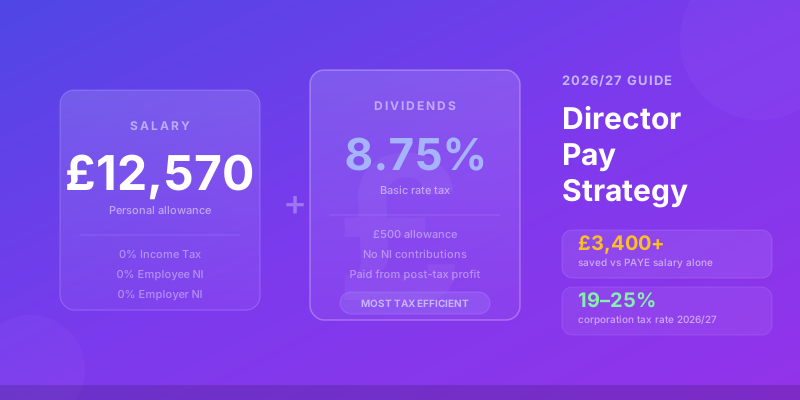
In this guide:
- Why the salary + dividend combination is still the most tax-efficient structure in 2026/27
- The exact salary and dividend figures to use this tax year
- A worked example showing how much you save versus a PAYE salary
- How corporation tax, the dividend allowance, and NI thresholds interact
- What changes if you are a higher or additional rate taxpayer
Most limited company directors in the UK are overpaying tax. Not through any fault of their own — the PAYE system is designed for employees, and if you simply pay yourself a salary through your own company without thinking about structure, you will pay income tax and National Insurance on money that could have been extracted at a far lower effective rate. The salary and dividend strategy is legal, HMRC-acknowledged, and used by hundreds of thousands of owner-managed businesses across the UK. Here is how it works for 2026/27.
Why Salary Plus Dividends Beats a Pure Salary
When you pay yourself a salary, you pay income tax at 20%, 40%, or 45% depending on the amount, plus employee National Insurance at 8% on earnings between £12,570 and £50,270. Your company also pays employer NI at 15% on earnings above £5,000. Stack those up and the combined tax cost on a £50,000 pure salary is substantial.
Dividends are different. Your company pays corporation tax on its profits first — at 19% for profits up to £50,000, or between 19% and 25% on profits up to £250,000 (marginal relief applies). What remains is distributable profit. When you take that as a dividend, you pay dividend tax — 10.75% for basic rate taxpayers, 35.75% for higher rate, and 39.35% for additional rate (2026/27 rates, increased from 8.75%/33.75% in 2025/26). No NI on dividends at all.
The combination of a low salary (using your personal allowance) plus dividends from after-tax profit is consistently the most efficient structure available to director-shareholders.
The 2026/27 Rates You Need to Know
Before modelling your pay structure, get these numbers fixed in your head:
| Parameter | 2026/27 Rate |
|---|---|
| Personal allowance | £12,570 |
| Basic rate income tax | 20% (£12,571–£50,270) |
| Higher rate income tax | 40% (£50,271–£125,140) |
| Employee NI primary threshold | £12,570/year |
| Employee NI rate (Class 1) | 8% up to £50,270 |
| Employer NI secondary threshold | £5,000/year |
| Employer NI rate | 15% |
| Corporation tax (profits ≤ £50,000) | 19% |
| Corporation tax (profits ≥ £250,000) | 25% |
| Dividend allowance | £500 |
| Dividend tax — basic rate | 10.75% |
| Dividend tax — higher rate | 35.75% |
| Dividend tax — additional rate | 39.35% |
The dividend basic and higher rates increased from 8.75% and 33.75% respectively on 6 April 2026. The key thresholds — personal allowance, NI thresholds, basic rate band — have been frozen since 2021 and remain frozen through to April 2028 under current government plans.
The Optimal Salary for 2026/27
The salary decision comes down to a trade-off between three variables: income tax, employee NI, and employer NI. There are two commonly used salary levels:
Option 1: £12,570 (the personal allowance)
Paying yourself exactly the personal allowance of £12,570 means:
- No income tax (the entire salary falls within your personal allowance)
- No employee NI (the Class 1 primary threshold is also £12,570)
- Employer NI: 15% × (£12,570 − £5,000) = £1,135.50 per year
The employer NI cost is the downside. However, your company gets a corporation tax deduction on the salary and the employer NI. On a 19% corporation tax rate, the net cost of that £1,135.50 employer NI bill is approximately £919.
Option 2: £9,100 (below the employer NI threshold)
Paying £9,100 eliminates employer NI entirely but misses out on £3,470 of tax-free personal allowance. That unused allowance is essentially wasted. For most directors, Option 1 at £12,570 comes out ahead — the corporation tax saving on the higher salary more than offsets the employer NI cost.
The verdict: £12,570 is typically optimal for a single-director company not claiming Employment Allowance. Run your exact figures through the Dividend vs Salary Calculator to confirm for your situation.
Dividend vs Salary Calculator
Model your exact salary and dividend split for 2026/27. Enter your target income and see your take-home pay, tax breakdown, and effective rate — all updated for current rates.
→ Open Dividend vs Salary Calculator
How Much Dividend Can You Pay?
Dividends can only be paid from distributable profits — that means retained earnings after corporation tax. You cannot pay a dividend that exceeds your company's accumulated retained profit, even if you have cash in the bank from loans or capital introduced.
The mechanics are straightforward:
- Your company earns revenue and deducts allowable expenses
- Corporation tax is charged on the resulting profit
- The after-tax profit is available for distribution as dividends
- You declare and pay dividends as a director-shareholder
There is no fixed schedule. You can pay dividends monthly, quarterly, or annually as suits your cash flow. Each payment should be documented with a dividend voucher (a simple statement showing the amount, date, and company details) and a board minute approving the distribution.
Worked Example: £60,000 Target Income
Suppose you want to extract £50,270 from your company in 2026/27. Here is how the salary plus dividend structure compares to a pure PAYE salary, assuming your company has sufficient profit.
Pure PAYE salary of £50,270:
| Tax/NI | Amount |
|---|---|
| Income tax (20% on £37,700) | £7,540 |
| Employee NI (8% on £37,700) | £3,016 |
| Employer NI (15% on £45,270) | £6,791 |
| Total tax cost | £17,347 |
| Take-home | £39,714 |
Salary £12,570 + Dividends £37,700 (basic rate only):
To keep all dividends within the basic rate band (total income ≤ £50,270), extract £37,700 in dividends on top of the £12,570 salary.
| Item | Amount |
|---|---|
| Director salary | £12,570 |
| Employer NI | £1,136 |
| Pre-tax profit needed for £37,700 dividend | ~£46,543 (at 19% corp tax) |
| Corporation tax on dividend profits | £8,843 |
| Dividend tax: £500 at 0%, £37,200 at 10.75% | £3,999 |
| Income tax on salary | £0 |
| Employee NI | £0 |
| Total tax cost | £13,978 |
| Take-home | £46,271 |
The salary and dividend structure saves approximately £6,293 compared to taking the same £50,270 as pure PAYE salary (take-home £39,978). If you extract dividends above the basic rate band, the higher rate of 35.75% applies — for example, £50,000 in dividends would push £12,300 into the higher rate band, adding £4,397 in extra dividend tax. The exact saving depends on your corporation tax rate and personal income tax band.
Higher and Additional Rate Taxpayers
Once your total income — salary plus dividends — exceeds £50,270, dividends above that point are taxed at 35.75% rather than 10.75%. The strategy still works, but the saving over a pure salary narrows significantly at higher income levels.
For income above £100,000, your personal allowance begins to taper at £1 for every £2 of income above the threshold. By £125,140, you have no personal allowance left and face an effective marginal rate of 60% on income in the £100,000–£125,140 band. Pension contributions are the primary tool for managing this — contributions reduce your adjusted net income, which can restore the personal allowance.
At income levels above £125,140 (where the additional rate of 39.35% on dividends applies), the corporation-tax-plus-dividend route is still marginally more efficient than PAYE for most structures, but the difference is smaller and professional tax advice is warranted.
The £500 Dividend Allowance
Every individual has a £500 tax-free dividend allowance per year. This was reduced from £1,000 in April 2024 and from £2,000 the year before. It applies before your dividend tax rates kick in. The allowance uses up part of your basic rate band even though no tax is paid on it — a point that matters if you are close to the 40% threshold.
For a husband-and-wife or civil partnership structure where both spouses hold shares, each has a £500 allowance, giving £1,000 of tax-free dividends between them annually.
Spouses and Family Members as Shareholders
If your spouse or civil partner has unused personal allowance or dividend allowance, issuing shares to them can reduce your household tax bill legally. Income splitting between spouses is recognised under UK tax law provided:
- The shareholding reflects genuine ownership
- The dividends paid match the shareholding percentage
- The arrangement is not a pure tax avoidance scheme with no commercial substance
HMRC can challenge arrangements under the settlements legislation (Section 624 ITTOIA 2005) where one spouse effectively controls all the income and the other is merely a nominee. This area is worth discussing with an accountant before implementing — the tax saving can be significant but the structure needs to be correct.
Record-Keeping Requirements
HMRC can investigate director pay structures, particularly where dividends are paid without adequate profit or documentation. Protect yourself with:
- Board minutes for each dividend declaration (a one-page document is sufficient)
- Dividend vouchers for each payment (name, date, amount per share, total)
- Company accounts that clearly show distributable retained earnings
- Personal tax returns that correctly declare all dividends received
Keep these records for at least six years after the tax year in question. HMRC has a six-year assessment window for errors and a 20-year window for deliberate non-compliance.
Calculate Your Optimal Structure
The right salary and dividend split depends on your specific profit level, corporation tax rate, other income sources, and pension contributions. The numbers above are a guide — your situation may differ.
Take-Home Pay Calculator
See your exact take-home pay at different salary levels, including income tax, NI, student loan, and pension contributions.
→ Open Take-Home Pay Calculator
Use the Dividend vs Salary Calculator to model your exact 2026/27 position, and the Corporation Tax Calculator to understand the tax your company pays before you reach distributable profit.
Frequently Asked Questions
What salary should a limited company director pay themselves in 2026/27?
Most directors pay themselves £12,570 — equal to the personal allowance. This means no income tax and no employee NI on the salary. The company pays employer NI of £1,135 on the amount above the £5,000 secondary threshold, but this is deductible against corporation tax, making the net cost around £919 for a company paying 19% corporation tax.
Can I pay myself dividends if my company has made a loss this year?
You can only pay dividends from accumulated distributable profits. If your company made a loss this year but has retained earnings from previous years, those previous profits are still distributable. If your company has no retained earnings at all, you cannot legally pay a dividend — any payment would be treated as an illegal distribution and would need to be repaid.
Is the salary and dividend strategy legal?
Yes. Paying a low salary and taking the remainder as dividends from after-tax profit is fully legal and HMRC-acknowledged. It is not a tax avoidance scheme. The government has legislated on related areas — such as IR35 for disguised employment — but the straightforward director salary plus dividend model for genuine owner-managed businesses has never been challenged.
What happens if I take more dividends than the company has in distributable profit?
The excess is treated as an illegal dividend. HMRC would require it to be repaid to the company and would tax it as a director's loan if not repaid within nine months of the company year end, triggering a 35.75% Section 455 tax charge on the outstanding balance.
Do dividends affect my state pension entitlement?
Dividends do not count as earnings for National Insurance purposes, so they do not build up state pension entitlement. Your salary does — provided it is above the Lower Earnings Limit (£6,708 for 2026/27). A salary of £12,570 keeps you above the LEL and accrues a qualifying year for state pension purposes.
Should I pay pension contributions instead of taking dividends?
Employer pension contributions are deductible against corporation tax and reduce the profits on which corporation tax is charged, making them highly tax-efficient at the company level. For higher earners managing the £100,000 personal allowance taper, pension contributions can restore the personal allowance and avoid the 60% effective marginal rate. Pension contributions and dividends are complementary strategies, not alternatives.
Have a question about this article?
Our team is happy to help with any questions about tax compliance. Get in touch and we will get back to you within one working day.
Ask Us a Question