What is Section 455 Tax?
Section 455 Corporation Tax (S455) is a 35.75% tax applied by HMRC when a UK limited company makes a director's loan that is not repaid in time. This tax is separate from any Corporation Tax main rate (25.0%) or small profits rate (19.0%) your company may owe. It applies even if your company doesn’t pay Corporation Tax.
When Does Section 455 Tax Apply?
S455 tax applies if:
- Your company lends money or provides any other benefit in kind to a director (or a participator, which includes shareholders who are not directors).
- - The loan or benefit is not repaid by the end of the accounting period or within 9 months and 1 day after it ends.
HMRC treats the loan as a distribution of profits rather than a salary or dividend, which is why it’s taxed at 35.75% instead of the usual dividend rates.
Rate transition: The S455 rate increased from 33.75% to 35.75% on 6 April 2026, in line with the dividend upper rate. Loans outstanding at the end of accounting periods beginning before 6 April 2026 are charged at 33.75%; those in periods beginning on or after 6 April 2026 are charged at 35.75%. If your accounting period straddles this date, seek advice on apportionment.
Key Deadlines for Repayment
Repayment deadlines are tied to your company’s accounting period end, not the tax year. The critical dates are:
- Repayment within the accounting period: If the loan is repaid before the end of the accounting period, no S455 tax is due.
- Repayment within 9 months and 1 day after the accounting period ends: This is the deadline to avoid the tax. For example, if your accounting period ends on 31 March 2027, you must repay the loan by 1 January 2028.
- Late repayment triggers S455 tax: If the loan isn’t repaid by the deadline, HMRC will charge 35.75% on the outstanding amount at the end of the accounting period.
How to Calculate Section 455 Tax
The tax is calculated on the outstanding loan balance at the end of the accounting period. For example:
- If your company’s accounting period ends on 31 March 2027 and you still owe £15,000 to a director on that date, the tax due is 35.75% of £15,000 = £5,062.50.
If the loan is repaid after the 9-month deadline but before HMRC issues a tax assessment, you can still avoid the tax by repaying it before the assessment is made.
Worked Examples for 2026/27
Example 1: Loan Repaid Within the Accounting Period
Scenario: Your company’s accounting period ends on 31 December 2026. On 15 November 2026, you repay a £12,000 director’s loan taken on 1 October 2026.
Outcome: Since the loan was repaid before the accounting period ended (31 December 2026), no S455 tax is due.
Example 2: Loan Repaid After the 9-Month Deadline
Scenario: Your company’s accounting period ends on 31 March 2027. On 1 June 2027, you repay a £12,000 director’s loan taken on 1 October 2026.
Outcome: The loan was still outstanding at the end of the accounting period (31 March 2027). The repayment date (1 June 2027) is within 9 months and 1 day of the accounting period end (31 March 2027), so no S455 tax is due.
Example 3: Loan Not Repaid Within the Deadline
Scenario: Your company’s accounting period ends on 31 March 2027. On 1 October 2026, you take a £12,000 loan and don’t repay it until 15 January 2028.
Outcome: The loan was outstanding at the end of the accounting period (31 March 2027) and wasn’t repaid until after the 9-month deadline (1 January 2028 is 9 months and 1 day after 31 March 2027). S455 tax is due: 35.75% of £12,000 = £4,050.
Example 4: Multiple Loans in the Same Period
Scenario: Your company’s accounting period ends on 31 December 2026. On 1 June 2026, you take a £12,000 loan and on 1 September 2026, you take another £5,000 loan. You don’t repay either loan by the end of the accounting period.
Outcome: The total outstanding loan at the end of the accounting period is £17,000 (£12,000 + £5,000). S455 tax is due: 35.75% of £17,000 = £5,737.50.
Example 5: Loan Partially Repaid
Scenario: Your company’s accounting period ends on 31 March 2027. On 1 October 2026, you take a £15,000 loan. By 31 March 2027, you’ve repaid £5,000, leaving £10,000 outstanding.
Outcome: The loan balance of £10,000 is still outstanding at the end of the accounting period, so S455 tax is due: 35.75% of £10,000 = £3,575.
Example 6: Loan Repaid and Reissued Within the Same Accounting Period
Scenario: Your company’s accounting period ends on 31 December 2026. On 1 November 2026, you take a £12,000 loan and repay it on 15 November 2026. On 1 December 2026, you take another £12,000 loan and don’t repay it until 15 March 2027.
Outcome: The first loan was repaid before the accounting period end, so no tax is due on it. The second loan was outstanding at the end of the accounting period and repaid after the 9-month deadline (15 March 2027 is within 9 months and 1 day of 31 December 2026), so no S455 tax is due.
Anti-avoidance warning (bed and breakfasting): HMRC ignores a repayment if the loan is re-borrowed within 30 days in a subsequent accounting period. Additionally, if the original loan exceeded £15,000 and the director intends to re-borrow £5,000 or more, the repayment may not be treated as genuine. See HMRC CTM61630.
Example 7: Loan Repaid After HMRC Assessment
Scenario: Your company’s accounting period ends on 31 March 2027. On 1 April 2027, you take a £12,000 loan. HMRC issues an assessment for S455 tax on 1 June 2027. You repay the loan on 1 July 2027.
Outcome: Even though you repaid the loan within 9 months and 1 day after the accounting period end, HMRC had already issued an assessment by the time of repayment. You must still pay the S455 tax: £4,050 (35.75% of £12,000).
How to Report Section 455 Tax to HMRC
Section 455 tax is reported on your Corporation Tax return (CT600) using the Loan to a Director section. You must include:
- The total amount of all loans and benefits to directors.
- The amount outstanding at the end of the accounting period.
- The tax due (35.75% of the outstanding amount).
You can file your CT600 online via HMRC’s online service (Corporation Tax Online). The deadline for filing your Corporation Tax return is 12 months after the end of the accounting period.
To reclaim S455 tax after a loan is repaid, use form CT600A if claiming within 2 years of the end of the accounting period in which the loan was originally made. For claims more than 2 years after that date, use form L2P instead.
Avoiding Section 455 Tax: Practical Steps
To avoid S455 tax, follow these steps:
Repay the Loan Within the Accounting Period
If you can repay the loan before the end of the accounting period, do so. This removes the outstanding balance that triggers the tax.
Repay Within 9 Months and 1 Day After the Accounting Period Ends
If repayment within the accounting period isn’t possible, ensure the loan is repaid within 9 months and 1 day after the period ends. For example, if your accounting period ends on 31 March 2027, repay by 1 January 2028.
Understand the Benefit-in-Kind Threshold
S455 tax applies to director’s loans of any amount — there is no minimum threshold. However, a separate benefit-in-kind charge (reported on form P11D) only applies when the loan exceeds £10,000 at any point during the tax year and interest is not charged at HMRC’s official rate (3.75% for 2025/26 and 2026/27). The company also pays Class 1A NIC at 13.8% on the notional interest benefit.
Consider Alternative Arrangements
Instead of a director’s loan, explore:
- Salary or dividends: These are taxed under income tax and NIC rules, but may be more cost-effective.
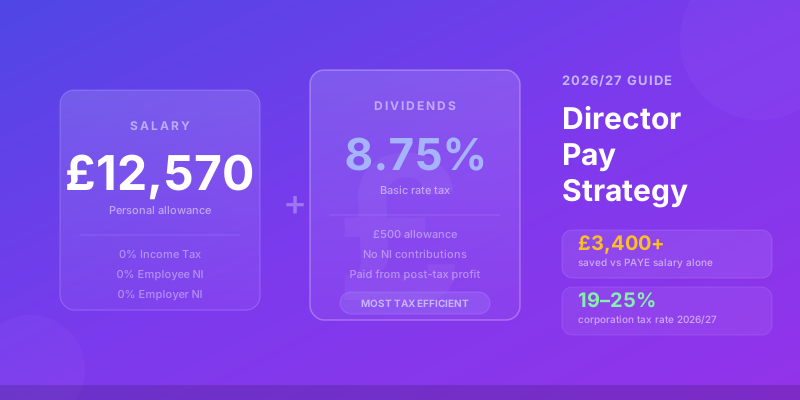
- Directors’ salary: Ensure it’s within the personal allowance (£12,570) to avoid income tax.
- Dividend payments: Use the dividend allowance (£500) to avoid dividend tax.
Penalties for Late Filing or Payment
If you miss the deadlines for filing or paying S455 tax, HMRC can impose penalties:
HMRC can impose penalties for late filing and late payment, plus interest on any outstanding amount. See gov.uk/tax-penalties for current rates.
These penalties are separate from the S455 tax itself and apply even if the loan is later repaid within the 9-month window.
How to Use Our Calculator to Check Your S455 Tax Bill
Our Directors' Loan Tax Calculator helps you:
- Calculate the S455 tax due on any outstanding director’s loans.
- Determine the impact of repaying loans on your tax liability.
- Compare the cost of a director’s loan versus salary or dividends.
Try the MBridge Directors' Loan Tax Calculator →
Common Misconceptions About Section 455 Tax
- "S455 tax only applies if the loan is never repaid": False. The tax is due if the loan isn’t repaid within 9 months and 1 day of the accounting period end, regardless of whether it’s repaid later.
- "Loans under £10,000 are exempt from S455": False. S455 applies to director’s loans of any amount. The £10,000 threshold only determines whether a separate benefit-in-kind charge arises.
- "HMRC will waive the tax if I repay the loan quickly": False. The tax is technically due once the 9-month-and-1-day deadline passes. However, as shown in Example 7, if repayment occurs before HMRC issues a formal assessment, the charge may not crystallise in practice.
What to Do If You Can’t Repay the Loan in Time
If you can’t repay the loan within the deadline, you must:
- Pay the S455 tax: Report the outstanding loan on your CT600 and pay 35.75% of the amount.
- Consider the tax implications: The loan may also trigger Income Tax (if it’s a beneficial loan — HMRC’s official rate is 3.75% for 2025/26 and 2026/27; loans above £10,000 where no or below-rate interest is charged trigger a benefit-in-kind) and National Insurance contributions (if it’s treated as earnings).
- Plan for repayment: Repaying the loan after the tax is paid will avoid further penalties, but does not trigger an immediate refund. However, you can reclaim S455 tax — the refund becomes available 9 months and 1 day after the end of the accounting period in which the loan was actually repaid. Note: you must make the claim within 4 years of the end of the accounting period in which the loan was repaid, or the right to reclaim is lost.
Section 455 Tax and Corporation Tax
S455 tax is not Corporation Tax. It’s a separate charge that applies when any director’s loan is not repaid within 9 months and 1 day of the accounting period end. Your company’s Corporation Tax liability (main rate 25.0% or small profits rate 19.0%) is calculated separately on its profits.
Section 455 Tax and Dividend Tax
S455 tax and dividend tax are separate. Dividend tax applies to payments made to shareholders, while S455 tax applies to loans made to directors (or participators). If you take a loan and later repay it as a dividend, you may still trigger S455 tax if the loan wasn’t repaid in time.
Section 455 Tax and Income Tax
S455 tax is not income tax. Income tax applies to salary payments and benefits in kind, while S455 tax applies specifically to any director’s loan not repaid within 9 months and 1 day of the accounting period end.
How to Manage Section 455 Tax in Your Business
To manage S455 tax effectively:
- Track loans and repayments: Keep a record of all loans to directors and their repayment dates to avoid exceeding the threshold.
- Set up reminders: Use accounting software to flag when loans are due for repayment within the 9-month window.
- Review accounting periods: If your company has multiple accounting periods, ensure loans are repaid within each period’s deadline.
- Consult an accountant: If you’re unsure about the rules or how to report the tax, seek guidance from an accountant familiar with HMRC’s requirements.
Section 455 Tax: A Quick Summary
- Rate: 35.75% (HMRC confirmed).
- Threshold: None — S455 applies to any outstanding director’s loan amount. (The £10,000 figure is for the separate benefit-in-kind charge only.)
- Deadline: 9 months and 1 day after the accounting period ends.
- Reporting: On your CT600 Corporation Tax return.
- Penalties: penalties for late filing and late payment vary — see gov.uk/tax-penalties for current rates.
Next Steps: Use the Calculator
Check your S455 tax liability with our Directors' Loan Tax Calculator to avoid surprises and penalties.
Try the MBridge Directors' Loan Tax Calculator →
- Input the outstanding loan balance at your accounting period end.
- Verify whether the loan was repaid within the 9-month window.
- Compare the cost of repaying the loan versus paying the tax.
HMRC’s rules are strict—use the calculator to ensure compliance.
This article is for general information only and does not constitute tax advice. Consult a qualified accountant for advice specific to your circumstances.
Have a question about this article?
Our team is happy to help with any questions about tax compliance. Get in touch and we will get back to you within one working day.
Ask Us a Question