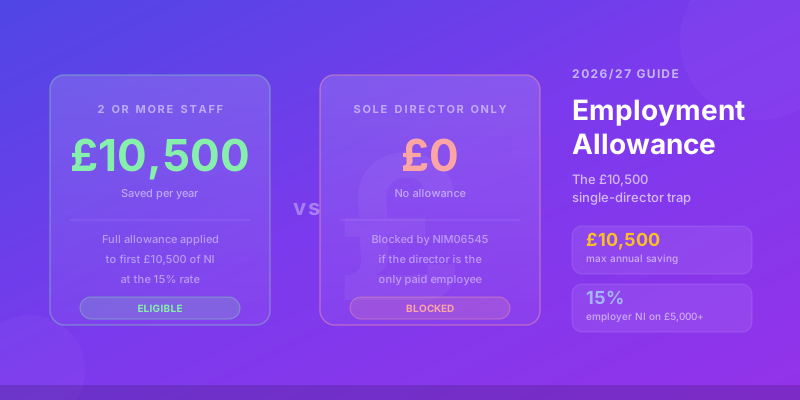
The Employment Allowance for 2026/27 is £10,500. Most UK small companies could wipe out their employer National Insurance bill with it. But HMRC manual NIM06545 blocks the most common setup: one director, no other staff. Here is how the £10,500 saving works, who qualifies, and the workaround that turns £150 of cost into £10,350 of saving.
Run your figures in the Employer NI Calculator 2026/27. It applies the £10,500 Employment Allowance automatically.
Employer NI before and after Employment Allowance (2026/27)
| Scenario | Annual gross pay | Employer NI before EA | Employer NI after EA |
|---|---|---|---|
| Single director on £12,570 | £12,570 | £1,135.50 | £1,135.50 (NOT ELIGIBLE for EA, sole-director rule) |
| Director plus 1 employee on £25k each | £50,000 | £6,000 | £0 |
| 5 employees averaging £30k | £150,000 | £18,750 | £8,250 |
| 10 employees averaging £35k | £350,000 | £45,000 | £34,500 |
| 20 employees averaging £35k | £700,000 | £90,000 | £79,500 |
Working: total earnings above the £5,000 secondary threshold times 15%, then Employment Allowance saving capped at £10,500.
- Row 1: (£12,570 minus £5,000) = £7,570 above secondary threshold, times 15% = £1,135.50. EA blocked by NIM06545.
- Row 2: 2 times (£25,000 minus £5,000) = £40,000, times 15% = £6,000. EA of £6,000 applied (under cap).
- Row 3: 5 times (£30,000 minus £5,000) = £125,000, times 15% = £18,750. EA capped at £10,500.
- Row 4: 10 times (£35,000 minus £5,000) = £300,000, times 15% = £45,000. EA capped at £10,500.
- Row 5: 20 times (£35,000 minus £5,000) = £600,000, times 15% = £90,000. EA capped at £10,500.
Want the same calc with your actual payroll? Run it through our Employer NI Calculator and see your post-EA bill in seconds.
What the Employment Allowance is and why it matters
The Employment Allowance is a £10,500 annual reduction in your company's employer Class 1 National Insurance liability for 2026/27. It is not a refund and it is not a tax credit. It is a credit that draws down inside your payroll as you submit each Employer Payment Summary, so it works automatically once HMRC accepts your initial claim.
A few features that matter in practice:
- It applies to employer secondary Class 1 NI only. It does not touch the employee's National Insurance, income tax, or Class 1A NIC on benefits.
- The £10,500 is the maximum reduction across the tax year. Once your employer NI bill reaches £10,500, the allowance is exhausted and you pay the standard 15% on every pound above that.
- The allowance cannot be carried back or carried forward. Any unused amount at 5 April is gone. A company that owes only £6,000 in employer NI gets £6,000 of relief, not £10,500.
- It is per company, not per employee. Connected and group companies must nominate one company to claim.
You can find the official figures on the gov.uk Rates and thresholds for employers 2026 to 2027 page.
How to check whether your company qualifies
There are three tests every employer must pass before HMRC accepts the claim:
1. You are a business or a charity. Sole traders cannot claim against Self-Employed NIC. The allowance is for employers paying Class 1 employer NI. Public bodies cannot claim (with some exceptions for care or support workers).
2. Less than half your work is in the public sector. If most of your invoices, by value or volume, come from public-sector clients, HMRC treats you as a public body for this purpose and excludes you. The rule catches contractors who do almost all their work for NHS Trusts, local authorities, or central-government departments.
3. You have at least one employee paid above the £5,000 secondary threshold who is not the sole director. This is the sole-director rule from HMRC manual NIM06545. The next section handles it in detail.
Two further constraints to keep in mind:
- Connected and group companies must elect a single claimant. If two companies share majority ownership or control, only one can claim. Both cannot.
- The £100,000 cap was removed from 6 April 2025. Older guidance and many accountants' blogs still say employers paying over £100,000 of employer NI in the prior year are excluded. That cap is gone. If your company was previously locked out, you can now claim for 2025/26 and 2026/27.
Full eligibility criteria are on the gov.uk Employment Allowance eligibility page.
The single-director trap
This is the rule that catches the most common UK micro-company setup: one director who pays themselves a salary and has no other employees.
HMRC's exact wording in the eligibility guidance: "if your company has only one director, they must not be the only employee liable for secondary Class 1 National Insurance." NIM06545 spells it out further: a company with just one director, where the only secondary Class 1 liability arises from that director's employment, does not qualify.
In practice this means:
- A solo limited company paying its director £30,000 a year owes (£30,000 minus £5,000) times 15% = £3,750 of employer NI, AND cannot use the £10,500 Employment Allowance to offset it. The full £3,750 is payable.
- The trap exists because HMRC's policy intent is to support employers who take on staff, not to subsidise tax-efficient owner-managed pay.
There are two practical workarounds.
Workaround A: add a second employee paid above the secondary threshold.
Hire someone (often a spouse, partner, or family member) onto the payroll at, say, £6,000 a year. That triggers (£6,000 minus £5,000) times 15% = £150 of new employer NI. The benefit: the company is no longer a sole-director-only company, NIM06545 stops biting, and the Employment Allowance becomes available against the company's TOTAL employer NI bill. Net saving versus paying no second wage: up to £10,500 minus £150 = £10,350.
Caveat that matters: the second worker must do real work for the pay. HMRC challenges sham wages where a spouse is on the payroll but does nothing for the business. The wage must be wholly and exclusively for the purposes of the trade. Keep evidence: a written job description, board minutes, and proof the work happened.
Workaround B: appoint a second director paid above the threshold.
This needs Companies House filings and a board minute, but it works the same way. Both directors must be paid above £5,000 for the rule to be cleared.
Honest health warning: if the company has no employer NI bill at all (because director salary stays under the £5,000 threshold), Employment Allowance has nothing to offset. The workaround opens the door to the credit, but the credit only saves real money if there is real employer NI to credit against.
How much your company could save
Look at the answer table at the top of this article. The pattern repeats: very small employers (one director plus one employee, or two directors) capture the full Employment Allowance because their employer NI bill sits below the £10,500 cap. Larger employers exhaust the cap and pay the difference at 15%.
The implication for owner-managed companies is straightforward:
- A husband-and-wife company paying £25,000 each saves £6,000 in employer NI outright. That is real cash that stays in the business.
- A small-team company with five employees averaging £30,000 saves £10,500. After EA, employer NI drops from £18,750 to £8,250. That is more than half the bill.
- A 20-employee company still saves £10,500 but it is a smaller share of the total bill. The allowance becomes a flat-fee discount on a much bigger liability.
The break-even point: any employer with at least £10,500 of annual employer NI captures the full saving. Companies below that point get a partial benefit, but they get every pound they pay back.
Plug your real payroll figures into the Employer NI Calculator 2026/27 for an exact figure.
How to claim Employment Allowance in your payroll software
The claim is a single tick-box in your payroll software's Employer Payment Summary (EPS). HMRC processes it automatically when your first EPS of the tax year reaches them.
Step by step:
1. Open your payroll software (Sage Business Cloud Payroll, Xero Payroll, QuickBooks Payroll, BrightPay, or any HMRC-recognised package). Find the company settings or HMRC submissions area. Look for a checkbox labelled "Employment Allowance" or "Claim Employment Allowance".
2. Tick the box for the 2026/27 tax year and save the setting. Your next EPS submission will carry a flag telling HMRC you intend to claim. If the software asks for a category (de minimis state aid sector), select the one that matches your trade. Most UK SMEs select "State aid rules do not apply to my business".
3. Run your next payroll as normal. The £10,500 credit draws down against your employer NI liability automatically. Your first month's employer NI may still show in full; the credit applies as soon as HMRC has acknowledged the EPS, usually within a few days.
A few practical points:
- Re-confirm each tax year. The claim does not auto-renew. You must tick the box again after 6 April every year.
- Backdating is allowed for up to four prior tax years. If you missed claims for 2022/23, 2023/24, 2024/25, or 2025/26, you can submit an amended EPS for each year. HMRC repays the difference, usually within 12 weeks.
- Confirm via your HMRC business tax account. Log in, find PAYE, and check the Employment Allowance section. The page shows the claim as live for the current tax year.
Common mistakes that cost you the allowance
1. Forgetting to renew each tax year. The single most common mistake. The claim does not roll over after 6 April. A company that claimed in 2024/25 but never re-ticked the box for 2025/26 loses the entire £10,500 for that year. There is no automatic carry-back; you must amend the EPS for the missed year.
2. Failing the public-sector-work test. Contractors who do most of their work for public bodies (NHS, councils, government departments) are not eligible. The test is "more than half" by value or volume, measured for each tax year. A company close to the line should keep an audit trail of public versus private invoices.
3. Claiming for domestic workers. Nannies, gardeners, household cleaners and similar staff fall under NIM06535 as "excluded liabilities". An employer who pays a nanny through PAYE cannot use the Employment Allowance against that wage bill. The exclusion applies even if the employer also has a separate business with eligible staff.
4. Both connected companies claiming. If a group has two trading companies under common control, only one can claim the £10,500. Both companies claiming triggers an HMRC compliance check and full repayment of the second company's relief, with interest. The same applies to two companies majority-owned by the same person, even without a holding-company structure.
5. Confusing Employment Allowance with the Apprenticeship Levy allowance. These are different reliefs. The Apprenticeship Levy applies to employers with pay bills above £3 million. The Employment Allowance is separate, runs against secondary Class 1 NI, and works through your EPS. Some payroll software bundles the settings together; check that you have the right box.
Stop guessing. Run your payroll through the Employer NI Calculator 2026/27 and see exactly how much Employment Allowance you would claw back.
Your next steps
- Check eligibility. Run your company through the three tests above. If you have two or more people on the payroll above £5,000, and you are a private-sector business, you almost certainly qualify.
- Run the calculator. Plug your actual payroll figures into the Employer NI Calculator 2026/27. The calculator factors in the £10,500 automatically and tells you the post-EA bill.
- Claim through your payroll software. Tick the Employment Allowance box on your next EPS submission. If you missed prior years, file amended EPS submissions for each year up to four back.
- Set an April reminder. Block a calendar entry for 6 April 2027 to re-confirm the claim for 2027/28. The HMRC system does not warn you if you forget.
- Get a sense-check for borderline cases. Group structures, mixed public-sector work, or off-payroll worker arrangements deserve a five-minute call with a qualified accountant before you submit.
FAQ
How much is the Employment Allowance for 2026 to 2027?
The Employment Allowance for the 2026 to 2027 tax year is £10,500. It is unchanged from the increased rate that took effect on 6 April 2025. HMRC has not announced any change for the 2027/28 tax year as of publication. The figure is published on the gov.uk Rates and thresholds for employers page.
Who is eligible for the Employment Allowance in 2026/27?
UK businesses and charities that pay employer Class 1 National Insurance are eligible, provided they meet three tests: less than half their work is in the public sector; if they have only one director, that director is not the only employee paid above the £5,000 secondary threshold; and if they belong to a connected group, only one company in the group claims.
Can a single-director company claim Employment Allowance in 2026/27?
No, not without adding a second employee paid above the £5,000 secondary threshold. HMRC's NIM06545 rule excludes companies where the only secondary Class 1 NIC liability arises from a single director's pay. A common workaround is to put a second person (often a spouse or co-director) on the payroll at £6,000 or more, doing genuine work for the company. Adding a second director paid above the threshold also works.
What is the employer National Insurance rate for 2026/27?
The employer secondary Class 1 NIC rate is 15% on earnings above the £5,000 annual secondary threshold. This rate has applied since 6 April 2025 and continues for 2026/27. Class 1A NIC on benefits in kind is also 15% (an increase from 13.8% that took effect on 6 April 2025; older articles citing 13.8% are out of date).
Do I still qualify for Employment Allowance if my company paid over £100,000 in NI last year?
Yes. The £100,000 NI-liability cap was removed from 6 April 2025. Employers paying any amount of employer NI in the prior year can now claim. This is a recent change, so a lot of older guidance still mentions the cap. Check the current gov.uk eligibility page if in doubt.
How do I claim Employment Allowance through my payroll software?
Tick the Employment Allowance box in your payroll software's Employer Payment Summary (EPS) settings. The setting is in the company or HMRC submissions area, usually under a heading like "Allowances" or "HMRC submissions". HMRC processes the claim automatically when your next EPS reaches them. Re-confirm each new tax year, and check your HMRC business tax account to confirm the claim is live.
This article is general information only and does not constitute tax advice. Consult a qualified accountant for advice specific to your circumstances.
Have a question about this article?
Our team is happy to help with any questions about tax compliance. Get in touch and we will get back to you within one working day.
Ask Us a Question