Twenty Five Years On, IR35 Is Still Causing Arguments
IR35 was introduced in 2000 to address what the government saw as tax avoidance by contractors working through personal service companies. The idea was straightforward enough: if you work through your own limited company but your actual working arrangements look and feel like employment, you should pay broadly the same tax as an employee. A quarter of a century later, it remains one of the most litigated areas of UK tax, generating a steady stream of tribunal decisions, HMRC investigations, and genuine uncertainty for contractors and engagers alike.
From 6 April 2026, the small company thresholds under the off payroll working rules are increasing. The turnover threshold moves from £10.2 million to £15 million, and the balance sheet threshold from £5.1 million to £7.5 million. The employee headcount threshold of 50 remains unchanged. This means thousands of additional companies will qualify as small from April 2026, and contractors engaged by those companies will once again be responsible for determining their own IR35 status.
Mutuality of Obligation
This is often the least understood of the three tests, but it is arguably the most fundamental. In a genuine employment relationship, there is a mutual obligation: the employer is obliged to offer work, and the employee is obliged to accept it.
In a genuine contractor relationship, there is no such obligation. The contractor is engaged to deliver a defined piece of work or service. Once that work is complete, the engagement ends. Each project, each statement of work, should stand alone.
Problems arise when the practical reality diverges from this model. If a contractor has been renewing their contract with the same client every six months for three years, receives a steady stream of work between formal engagements, and is effectively expected to be available whenever the client needs them, the mutuality of obligation starts to look like employment.
The strength of your position depends on whether you genuinely operate without a commitment to ongoing work. If you have multiple clients across the year, gaps between engagements, and documented occasions where you declined work, your position is considerably stronger.
Control
The control test asks who decides how the work is done. An employee typically works under the direction and supervision of their employer. A self employed contractor is engaged to deliver an outcome and has broad discretion over how they achieve it.
In practice, this is nuanced. Contractors working in regulated environments or on client premises will inevitably operate within constraints. The question is not whether any direction exists, but whether the nature and degree of control is consistent with self employment.
Indicators of low control include setting your own hours without approval requirements, working from your own premises, making autonomous decisions about methodology, and not being subject to performance management processes. Indicators of high control include being directed on a day to day basis by a line manager, being required to work fixed hours at a fixed location, and being subject to the same disciplinary processes as employees.
Right of Substitution
The right of substitution is a powerful indicator of self employment, but only if it is genuine. The question is whether your contract genuinely permits you to send a suitably qualified substitute to perform the services in your place, and whether that right has any practical basis in reality.
HMRC and the courts have been increasingly sceptical of contractual substitution clauses inserted purely to tick the IR35 box. If there is no realistic prospect that you would ever exercise a substitution right, the clause offers limited protection. A genuine right of substitution is most credible when you have actually used it, when the engager demonstrably does not require your personal service, and when you bear the cost of finding and paying any substitute yourself.
What Actually Triggers HMRC Investigations
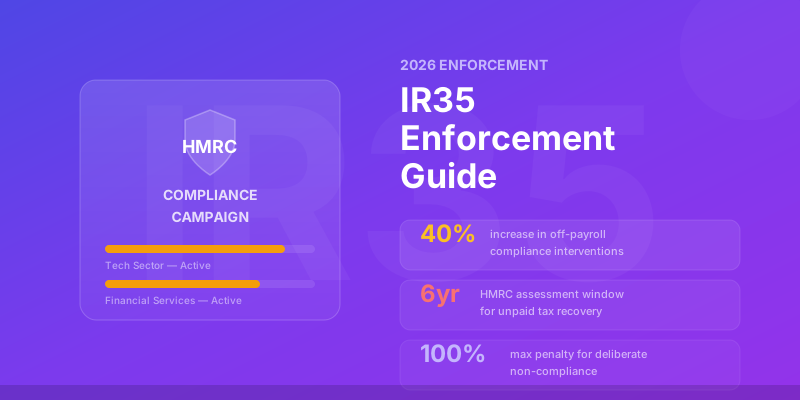
HMRC targets IR35 investigations using a combination of risk profiling and sector specific campaigns. The sectors that attract most attention are technology, financial services, oil and gas, and construction. Contractors who have been with a single engager on rolling contracts for more than 18 months, who have never had more than one client in a year, and whose invoices look structurally similar to payslips are at higher risk.
The CEST tool on GOV.UK is HMRC's own online determination tool. Using it and retaining the result provides some protection, though HMRC will not stand behind CEST results if the information entered was inaccurate.
Assessing Your Own Status from April 2026
If your engager will qualify as small from 6 April 2026, the responsibility for status assessment shifts back to you. Documenting the basis for your determination, with reference to the three tests above and any supporting evidence from the contract and working practices, is essential. An undocumented determination that turns out to be wrong is harder to defend than a careful assessment that reached the same conclusion.
The IR35 Assessment Tool from MBridge walks through the key status tests, weights the indicators in line with established case law, and produces a written summary of the factors supporting your determination. For contractors working with newly small clients from April 2026, having a structured record of your assessment is good practice.
The Wider Point
IR35 is not going away. The most effective protection is not clever contract drafting. It is ensuring that the day to day reality of how you work is genuinely consistent with self employment, and being able to evidence that if asked.
Have a question about this article?
Our team is happy to help with any questions about HMRC compliance. Get in touch and we will get back to you within one working day.
Ask Us a Question