HMRC Is Actively Targeting IR35
2026 marks a significant escalation in HMRC's IR35 enforcement. After years of refining its approach following the 2021 off-payroll reforms, HMRC now has mature processes, dedicated compliance teams, and — critically — the data infrastructure to identify non-compliance at scale.
The key developments:
- Sector-specific compliance campaigns targeting technology, financial services, and defence contractors
- Cross-referencing company accounts with PAYE data to identify businesses using contractors without applying the off-payroll rules
- Automated risk scoring that flags companies with high contractor spend but no off-payroll assessments on record
- Increased use of information powers — HMRC is issuing more Schedule 36 notices requiring businesses to produce IR35 documentation
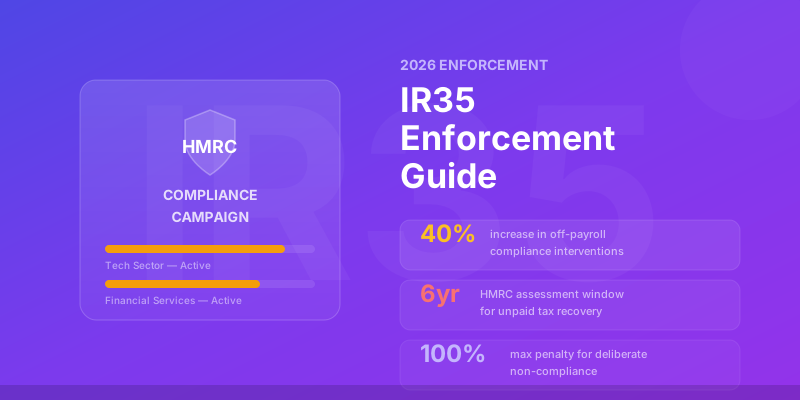
This is not speculative. HMRC's annual report confirmed a 40% increase in off-payroll compliance interventions in 2025/26, with planned further increases.
Who Is Being Investigated?
HMRC's IR35 enforcement operates on three levels:
1. Large Employers — Compliance Checks
Major employers and agencies receive structured compliance checks examining their end-to-end off-payroll process. HMRC reviews:
- Status Determination Statements (SDS) for accuracy and reasoning
- Whether the organisation has a documented process for making determinations
- Evidence of "blanket assessments" (treating all contractors the same without individual review)
- Response to contractor disagreements
2. Medium Businesses — Targeted Campaigns
HMRC's campaigns target medium-sized businesses (above the "small company" exemption) in high-risk sectors. Triggers include:
- High volume of payments to Personal Service Companies (PSCs) with no corresponding PAYE deductions
- Industry-wide campaign activity (currently: IT consulting, financial services, NHS locums)
- Tip-offs from disgruntled workers or competitors
- Discrepancies between corporation tax returns and PAYE filings
3. Contractors — Individual Enquiries
For engagements where the small company exemption applies (client meets two of: turnover ≤ £10.2m, balance sheet ≤ £5.1m, ≤ 50 employees), the contractor's PSC remains responsible for IR35. HMRC opens individual enquiries into PSC tax returns where it suspects inside-IR35 income is being extracted as dividends.
The Penalties
Getting IR35 wrong can be expensive. The liability framework depends on who was responsible for the determination:
Where the client is responsible (medium/large employers):
- Unpaid PAYE and employee NI for up to 6 years (or 20 years if deliberate)
- Employer NI at 15% on all historical payments
- Interest from the date the tax should have been paid
- Penalties of 0% (reasonable care) to 100% (deliberate) of the underpaid tax
Where the contractor is responsible (small company exemption):
- Income Tax and NI on deemed employment income
- Loss of dividend tax treatment on extracted profits
- Penalties on the same 0–100% scale
Realistic example: A contractor earning £100,000 per year through a PSC, found to be inside IR35 for 3 years:
| Item | Approximate liability |
|---|---|
| Additional Income Tax (3 years) | £24,000–£36,000 |
| Employee NI (3 years) | £9,000–£12,000 |
| Employer NI (3 years) | £27,000–£33,000 |
| Interest | £3,000–£6,000 |
| Penalties (if careless) | £12,000–£30,000 |
| Total exposure | £75,000–£117,000 |
The Status Determination Statement
If you are a medium or large employer engaging contractors, you must issue a Status Determination Statement (SDS) for each engagement. HMRC is now checking:
- Is the SDS specific to the engagement? Generic or template statements that are not tailored to the individual role are being challenged.
- Does it include reasons? The SDS must explain why the determination was reached, not just state the conclusion.
- Was it communicated correctly? The SDS must go to both the contractor and the next party in the chain (usually the agency).
- Is there a disagreement process? You must have a process for contractors to challenge the determination, and you must respond within 45 days.
Blanket assessments — determining all contractors as inside or outside without individual review — are the single most common error HMRC is targeting.
How to Protect Yourself
For Contractors
- Document your working practices — keep records of how you actually work: your own equipment, ability to substitute, financial risk, multiple clients
- Review your contract — ensure it reflects the reality of how you work, not just boilerplate
- Use a structured assessment tool — our IR35 Status Checker evaluates all six HMRC factors
- Challenge incorrect determinations — if a client issues an inside-IR35 SDS you disagree with, use the formal disagreement process within 45 days
- Keep evidence — emails, invoices, and project documentation that demonstrate genuine self-employment
For Hiring Businesses
- Assess each engagement individually — never issue blanket determinations
- Document your reasoning — the SDS must include specific reasons based on the working arrangements
- Train your hiring managers — they need to understand what factors matter and how to answer HMRC questions
- Respond to disagreements on time — the 45-day deadline is strict; failure to respond can transfer liability
- Review annually — working practices change, and a determination made two years ago may no longer be accurate
CEST: Useful but Limited
HMRC's Check Employment Status for Tax (CEST) tool remains the "official" way to make IR35 determinations, and HMRC has said it will stand by CEST results provided the information entered is accurate.
However, CEST has known limitations:
- Approximately 21% of assessments return "unable to determine"
- It does not adequately weight the mutuality of obligation factor
- It treats all factors equally, when case law has established that some (particularly substitution) carry more weight
- It cannot assess nuanced scenarios like part-substitution rights or limited financial risk
For this reason, many advisers recommend using CEST as a starting point but supplementing it with a more detailed assessment that covers all six factors with appropriate weighting.
Check Your IR35 Status
Use the MBridge IR35 Status Checker to:
- Assess all six HMRC employment status factors with weighted scoring
- Get a clear inside/outside determination with confidence level
- Generate a documented assessment you can keep as evidence
- Compare your result against HMRC's CEST methodology
Free for your first assessment. Accountant plans include unlimited checks and PDF reports for client files.
Have a question about this article?
Our team is happy to help with any questions about HMRC compliance. Get in touch and we will get back to you within one working day.
Ask Us a Question