MTD for Income Tax Is Here
From 6 April 2026, Making Tax Digital for Income Tax Self Assessment (MTD ITSA) becomes mandatory for sole traders and landlords with qualifying income over £50,000. This is the biggest change to self-assessment since it launched in 1996.
Instead of filing one annual tax return, affected taxpayers must now submit quarterly updates to HMRC using MTD-compatible software. And with quarterly updates comes a new penalty regime that works very differently from the old system.
Who Is Affected?
MTD ITSA rolls out in phases based on qualifying income — your combined gross self-employment and property income before expenses:
| From | Income Threshold | Who |
|---|---|---|
| 6 April 2026 | £50,000+ | Sole traders, landlords, partnerships |
| 6 April 2027 | £30,000+ | Same groups |
| 6 April 2028 | £20,000+ | Same groups |
Limited companies are not included. MTD for Corporation Tax has been consulted but has no confirmed start date.
Employment income, pensions, savings, and dividends do not count towards the qualifying income threshold.
The New Penalty Points System
The old system of automatic fixed penalties for late filing is being replaced with a points-based system. Here is how it works:
How Points Accrue
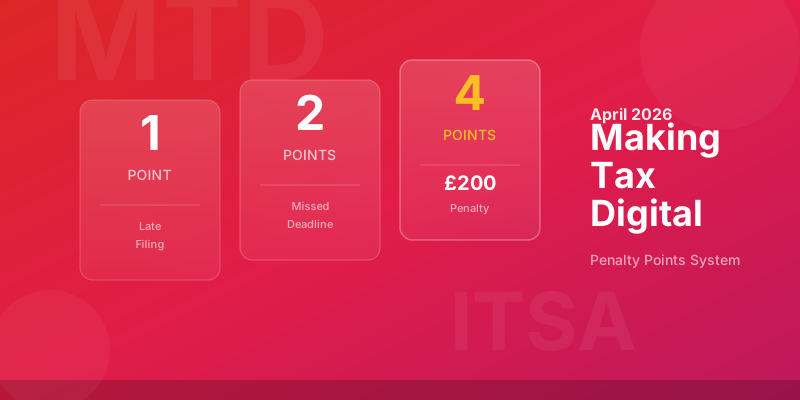
Every time you miss a quarterly update deadline, you receive 1 penalty point. Points accrue silently — there is no financial penalty until you reach the threshold.
Points Thresholds
| Filing Frequency | Points Threshold |
|---|---|
| Annual | 2 points |
| Quarterly | 4 points |
| Monthly | 5 points |
For most MTD ITSA taxpayers filing quarterly, the threshold is 4 points.
What Happens at the Threshold
Once you reach the threshold, you receive a £200 fixed penalty. Every subsequent late submission also attracts a £200 penalty — there is no further points buffer.
Resetting Points
To reset your points to zero, you must:
- File on time for 12 consecutive months (for quarterly filers)
- Submit all outstanding returns from the previous 24 months
This is not a quick fix. If you reach the threshold, it takes a full year of perfect compliance to clear your record.
Late Payment Penalties
Separate from submission penalties, there are charges for paying tax late:
| When | Charge |
|---|---|
| Day 16 after due date | 2% of outstanding tax |
| Day 31 | Additional 2% of outstanding tax |
| Day 31 onwards | 4% per annum on outstanding balance |
On top of this, late payment interest is charged at the Bank of England base rate plus 2.5% — currently around 7.25% — calculated daily.
Worked Example
A sole trader owes £10,000 in tax and pays 60 days late:
- Day 16 charge: £10,000 × 2% = £200
- Day 31 charge: £10,000 × 2% = £200
- Daily charge (day 31–60): £10,000 × 4% × 30/365 = £32.88
- Interest (60 days): £10,000 × 7.25% × 60/365 = £119.18
- Total cost of being 60 days late: £552.06
That is on top of the tax itself. And penalty points for late submissions can push the total even higher.
Quarterly Deadlines
Under MTD ITSA, you must submit updates by these deadlines:
| Quarter | Period | Deadline |
|---|---|---|
| Q1 | 6 April – 5 July | 7 August |
| Q2 | 6 July – 5 October | 7 November |
| Q3 | 6 October – 5 January | 7 February |
| Q4 | 6 January – 5 April | 7 May |
After Q4, you also submit an End of Period Statement (EOPS) confirming figures are complete, followed by a Final Declaration (replacing the old SA return) by 31 January.
Software Requirements
MTD requires you to keep digital records and submit updates using MTD-compatible software. This means:
- Spreadsheets alone are not compliant. You can use spreadsheets for record-keeping, but they must be digitally linked to submission software — no manual typing of figures.
- Paper records are not compliant. You must switch to digital record-keeping.
- Major providers like Xero, Sage, QuickBooks, and FreeAgent all offer MTD-compatible plans. Check your specific plan includes MTD filing.
HMRC maintains a list of recognised MTD software on gov.uk.
The Soft Landing
HMRC has indicated a "light touch" approach for the first year of MTD ITSA. Penalty points will accrue, but HMRC may show leniency for reasonable excuses during the transition period.
This is not a formal exemption. You should still aim to file on time from day one. The soft landing means HMRC might accept a reasonable excuse for a missed deadline — it does not mean penalties are waived automatically.
What You Should Do Now
- Check if you are affected — use our MTD Compliance Checker to assess your income against the thresholds
- Get MTD-compatible software set up and connected to HMRC before April
- Start keeping digital records now, even if your deadline is 2027 or 2028
- Know your quarterly deadlines and set calendar reminders
- Talk to your accountant about how MTD changes your workflow
Calculate Your Penalty Risk
Use the MBridge MTD Compliance Checker to:
- Check if Making Tax Digital affects your business
- Assess your software readiness
- Calculate exactly what HMRC penalties could cost you
- Get a personalised checklist of actions
It takes under 2 minutes and it is completely free.
Have a question about this article?
Our team is happy to help with any questions about HMRC compliance. Get in touch and we will get back to you within one working day.
Ask Us a Question