What Are the IR35 Off-Payroll Working Rules?
IR35 (officially the “off-payroll working rules”) targets arrangements where a worker provides services to a client through an intermediary — typically a Personal Service Company (PSC) — but would be considered an employee if engaged directly. The rules ensure that workers who are effectively employees pay broadly the same Income Tax and National Insurance as direct employees.
The rules were reformed in the public sector from April 2017, and extended to medium and large private-sector clients from 6 April 2021.
Who Determines IR35 Status?
This depends on the size of the client:
| Client type | Who determines status? |
|---|---|
| Public sector (all sizes) | The client |
| Medium/large private sector | The client |
| Small private sector | The worker’s own PSC |
If you are a small company in the private sector, you are exempt from the off-payroll working rules as a client. Your contractors’ PSCs remain responsible for determining their own employment status and paying the correct tax.
Small Company Exemption: Updated Thresholds
The small company definition comes from the Companies Act 2006. The financial thresholds were increased with effect from 6 April 2025 (for company accounts), with the practical IR35 impact phased in from the 2026–27 tax year onwards depending on your accounting period.
| Criterion | Old threshold (to 5 April 2025) | New threshold (from 6 April 2025) |
|---|---|---|
| Annual turnover | £10.2 million or less | £15 million or less |
| Balance sheet total | £5.1 million or less | £7.5 million or less |
| Average employees | 50 or fewer | 50 or fewer (unchanged) |
These thresholds apply to the client company (the business receiving the worker’s services), not the contractor’s PSC.
Important change: HMRC estimates that approximately 14,000 companies are being reclassified as small under the new higher thresholds. If your company now qualifies as small, IR35 responsibility shifts back to the contractor’s PSC — you no longer need to make status determinations or issue SDSs.
Group structures: Where a company is part of a wider group, the thresholds are assessed on an aggregated group basis — not just the individual hiring entity. A subsidiary that appears small on its own may not qualify if its parent group exceeds the thresholds.
Size confirmation obligation: If a contractor or recruitment agency formally requests written confirmation of your company size, you must respond within 45 days. Failure to respond means the off-payroll rules continue to apply to that engagement regardless of your actual size.
When do the new thresholds actually apply to your company?
IR35 size classification is assessed by reference to the prior financial year’s accounts, not the current one. Companies whose prior financial year ended before 6 April 2026 and who met the new thresholds in that year will already benefit from the April 2026 exemption. For companies whose most recently filed accounts (2024–25) showed them as medium-sized under the old thresholds, the practical impact will not be felt until the 2027–28 tax year, once 2025–26 accounts are assessed against the new criteria.
The two-year rule under the Companies Act applies in addition: a company that has only just fallen below the new thresholds must meet them for two consecutive financial years before it is formally reclassified as small. Conversely, a company that grows above the thresholds must exceed them for two consecutive years before it becomes a medium/large client.
If you are unsure when the exemption applies to your company, check your most recently filed accounts and seek specialist advice.
What Medium and Large Clients Must Do
If your company does not qualify as small (i.e. it exceeds at least 2 of the 3 thresholds on a group-aggregated basis for two consecutive years), you must:
1. Determine the Worker’s Employment Status
Assess whether each contractor engaged through a PSC would be an employee if engaged directly. Use HMRC’s Check Employment Status for Tax (CEST) tool to help. HMRC will stand by CEST results as long as the information provided is accurate.
The three key tests HMRC applies are:
- Personal service: Must the worker do the work personally, or can they send a substitute?
- Mutuality of obligation: Is the client obliged to offer work and the worker obliged to accept it?
- Control: Does the client control what, how, when, or where the work is done?
2. Issue a Status Determination Statement (SDS)
For each contractor, you must provide a written Status Determination Statement that includes:
- Your determination (inside or outside IR35)
- The reasons for your conclusion
- Information about the worker’s right to dispute
The SDS must be passed to the worker and the party you contract with (e.g. the agency or PSC).
3. Respond to Disputes Within 45 Days
If a contractor disagrees with your determination, they can raise a dispute. You must:
- Consider their representations
- Respond within 45 days with either a revised or confirmed determination
- Provide reasons for your decision
If you fail to respond within 45 days, you become the deemed employer and are liable for the tax.
4. Deduct Tax as the Deemed Employer
If a worker is determined to be inside IR35, the fee-payer (the party paying the PSC) must:
- Deduct Income Tax and employee National Insurance from the fee
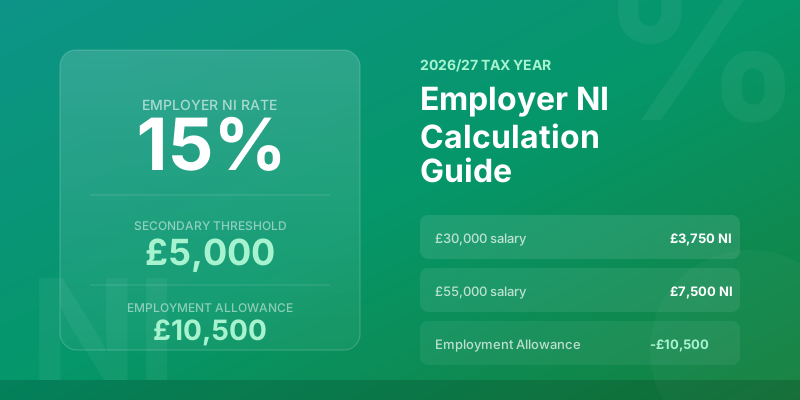
- Pay employer National Insurance at 15% above the £5,000 secondary threshold (these rates have been in effect since 6 April 2025, following the increase from 13.8% and reduction of the threshold from £9,100)
- Pay the Apprenticeship Levy where applicable
- Report payments through Real Time Information (RTI)
Note: The deemed employer does not deduct student or postgraduate loan repayments — the worker handles these through Self Assessment.
What Contractors Must Do
If you work through a PSC and your client is a small private-sector company, you remain responsible for determining your own IR35 status and paying the correct tax.
For all other clients (public sector, medium/large private sector), the client determines your status. If they determine you are inside IR35:
- Tax and NI will be deducted from your fees before payment
- You should check the determination is reasonable and dispute it if you disagree
5% allowance — largely abolished: The 5% allowance for PSC running costs was abolished for public sector engagements from April 2017 and for medium/large private sector engagements from April 2021. It only remains available where the PSC is self-assessing its own IR35 status (i.e. when the client is a small private-sector company). For any worker whose status has been determined as inside IR35 by a client, the 5% allowance does not apply.
HMRC’s CEST Tool
The Check Employment Status for Tax tool is available at gov.uk/guidance/check-employment-status-for-tax. It provides one of three outcomes:
- Employed for tax purposes (inside IR35)
- Self-employed for tax purposes (outside IR35)
- Unable to determine — seek specialist advice
HMRC will stand by the result provided the information entered is accurate. The tool is anonymous — no identifying details are collected.
Penalties for Getting It Wrong
HMRC can impose penalties for incorrect status determinations:
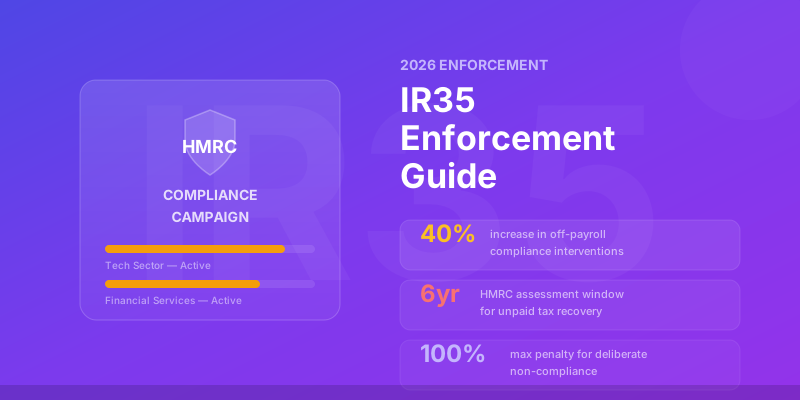
- 0% — if you took reasonable care
- Up to 30% — for careless errors
- Up to 100% — for deliberate non-compliance
Additionally, if HMRC finds that a worker should have been inside IR35, the deemed employer will be liable for:
- Unpaid Income Tax
- Unpaid employee and employer National Insurance
- Interest on late payments
- Potential penalties on top
Common Misconceptions
- “Small companies must determine contractor status” — False. Small companies (meeting 2 of 3 Companies Act thresholds for two consecutive years) are exempt. The contractor’s PSC determines status.
- “If I use CEST and get ‘outside IR35’, I’m safe forever” — The determination must reflect the actual working arrangements. If arrangements change, status may change.
- “IR35 only applies to IT contractors” — IR35 applies to any worker providing services through an intermediary in any sector.
- “A written contract saying ‘self-employed’ is enough” — HMRC looks at the actual working relationship, not just what the contract says.
- “The new thresholds mean I’m immediately small” — Not necessarily. IR35 size is based on your prior year’s accounts, and the two-year rule means your company must meet the criteria for two consecutive financial years before the exemption applies.
- “My subsidiary is small, so it’s exempt” — Not if it’s part of a group that exceeds the thresholds on an aggregated basis.
How to Use Our IR35 Checker
Our IR35 Status Checker helps you assess whether a contractor engagement is likely inside or outside IR35 based on the three employment tests. It takes under 60 seconds and gives you an immediate indication.
Try the MBridge IR35 Checker →
Key Dates and Deadlines
- 6 April 2025: New small company thresholds took effect for company accounts
- 6 April 2026: New umbrella company PAYE rules (Joint & Several Liability) — where an umbrella company fails to pay PAYE or NICs, liability can be transferred up the supply chain to the recruitment agency, or to the end client where no agency is involved. End clients should ensure any umbrella companies used are fully compliant
- 2027–28 tax year: When most companies will first feel the practical IR35 effect of the new thresholds (based on 2025–26 prior-year accounts)
- SDS: Must be provided before the worker starts (or as soon as reasonably practicable)
- Dispute response: 45 days from receiving the worker’s representations
- Record keeping: Retain all IR35 assessments, SDS documents, and dispute records for at least 6 years
HMRC Resources
- Understanding off-payroll working (IR35)
- Check employment status for tax (CEST tool)
- Off-payroll working rules for clients
This article is for general information only and does not constitute tax advice. Consult a qualified accountant or employment law specialist for advice specific to your circumstances.
Have a question about this article?
Our team is happy to help with any questions about UK compliance. Get in touch and we will get back to you within one working day.
Ask Us a Question