UK VAT Registration Threshold 2026-27: £90,000 Rolling 12-Month Test
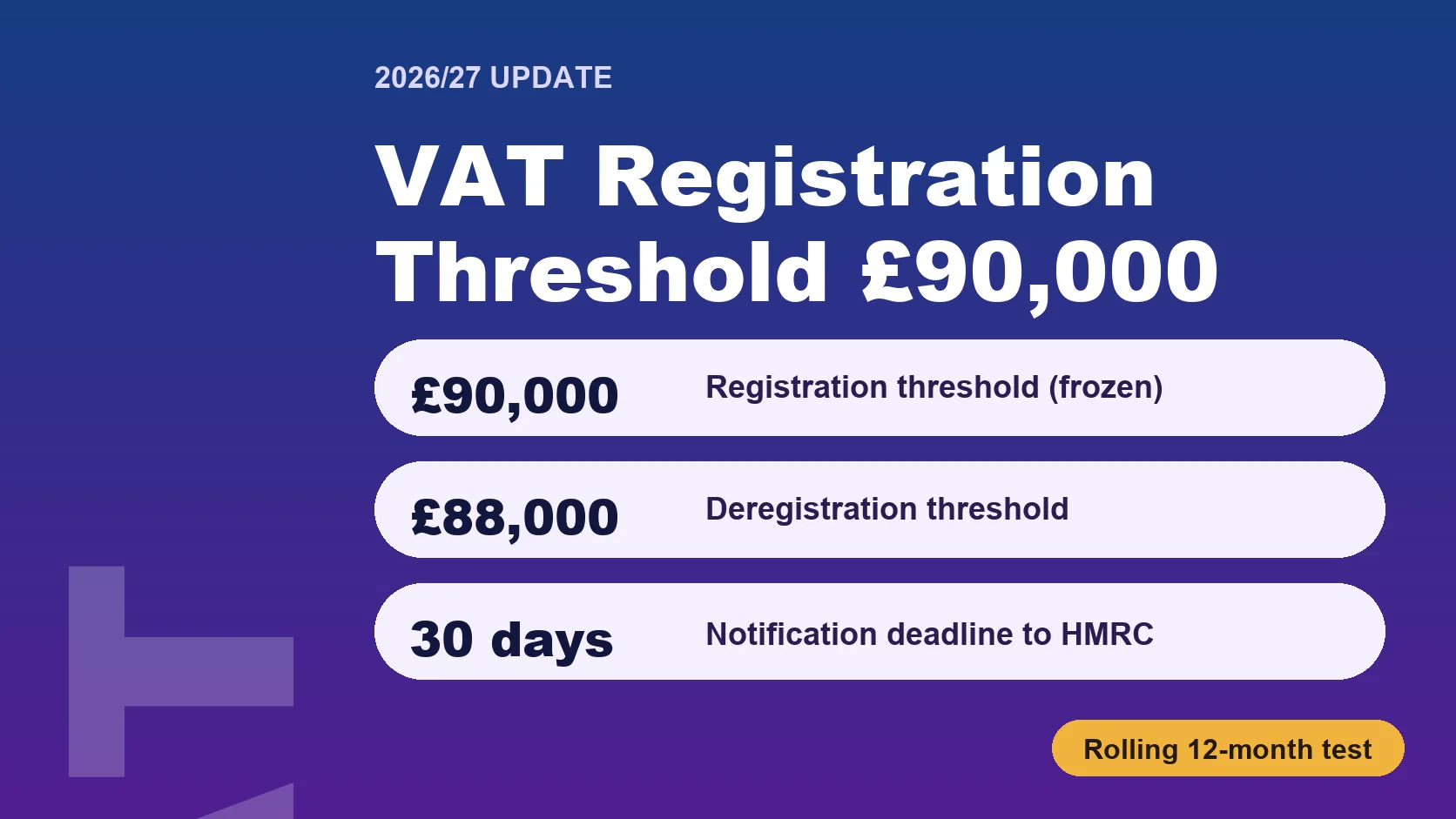
The VAT registration threshold for UK businesses remains frozen at £90,000 for the 2026-27 tax year. This rolling 12-month test applies regardless of when the threshold is crossed. Deregistration occurs at £88,000. Businesses must notify HMRC within 30 days of either crossing the threshold or expecting to do so in the next 30 days. These rules, unchanged since 2024, are governed by Schedule 1 of the Value Added Tax Act 1994 and HMRC's VAT Notice 700/1 and 700/11.
This guide is for UK SMEs, sole traders, and small Ltd companies approaching or near the VAT registration threshold. It explains how the rolling 12-month test works, when to notify HMRC, and what counts toward taxable turnover.
The £90,000 rolling 12-month test in plain English
The rolling 12-month test checks your taxable turnover over any 12-month period. If it exceeds £90,000, you must register for VAT. If it's expected to exceed £90,000 in the next 30 days, you must also register.
There are two 12-month periods: look-back and look-forward.
Look-back period is the 12 months before the current month. If your turnover in this period exceeds £90,000, you must register for VAT.
Look-forward period is the 30-day period starting from the day you expect to exceed £90,000. If you expect to exceed the threshold during this period, you must register for VAT.
Example: Tradesperson crossing £90,000 mid-year
| Month | Turnover (£) | 12-Month Total (£) | Exceeds £90k? |
|---|---|---|---|
| Jan | 5,000 | 5,000 | No |
| Feb | 6,000 | 11,000 | No |
| Mar | 7,000 | 18,000 | No |
| Apr | 8,000 | 26,000 | No |
| May | 9,000 | 35,000 | No |
| Jun | 10,000 | 45,000 | No |
| Jul | 11,000 | 56,000 | No |
| Aug | 12,000 | 68,000 | No |
| Sep | 13,000 | 81,000 | No |
| Oct | 14,000 | 95,000 | Yes |
| Nov | 15,000 | 109,000 | Yes |
| Dec | 16,000 | 125,000 | Yes |
In October, the rolling 12-month total crossed £90,000. Under the look-back rule the business must register from the first day of the second month after the month in which the threshold was breached. October plus two months means the registration effective date is 1 December 2026. The 30-day notification deadline to HMRC ends on 30 November 2026.
When you must notify HMRC and when registration starts
There are two 30-day clocks:
- Look-back clock: If you exceed the £90,000 threshold in the past 12 months, you must notify HMRC within 30 days of the end of the month in which the threshold was crossed.
- Look-forward clock: If you expect to exceed the threshold in the next 30 days, you must notify HMRC within 30 days of the day you expect to exceed it.
Effective registration date rules
Look-back: Registration begins on the first day of the second month after the month in which the threshold was crossed.
Look-forward: Registration begins on the day you expect to exceed the threshold.
Deregistering at £88,000
Deregistration occurs when your taxable turnover falls below £88,000 for 12 consecutive months. This is the symmetrical threshold to the registration threshold.
Exception from deregistration
If you expect your turnover to exceed £88,000 within the next 12 months, you can apply to remain registered. This is a written application to HMRC.
What counts toward taxable turnover
All taxable supplies count toward the £90,000 figure. Taxable supplies include:
- Standard-rated supplies (20%)
- Reduced-rate supplies (5%)
- Zero-rated supplies, for example most food, children's clothing, books and physical exports
Excluded from the turnover calculation:
- VAT-exempt supplies, for example residential lettings, most financial services, insurance, postage stamps, and some education and healthcare
- Supplies that fall outside the scope of UK VAT, for example services with a place of supply outside the UK under the general B2B rule
- One-off sales of capital assets the business uses in its own trade, such as a van or a piece of plant
Common edge cases:
- Residential rental income is exempt, not zero-rated, and is excluded from the registration test.
- Services billed to overseas business customers are usually outside the scope of UK VAT under the general place-of-supply rule, so they sit outside the threshold test.
- Sales of second-hand goods are normally standard-rated (or fall under the margin scheme once registered) and count toward the threshold.
- Zero-rated exports still count toward the £90,000 even though no VAT is charged on the sale itself.
Worked example: a tradesperson crossing £90,000 in November 2026
A tradesperson has the following monthly turnover in 2026:
| Month | Turnover (£) |
|---|---|
| Jan | 5,000 |
| Feb | 6,000 |
| Mar | 7,000 |
| Apr | 8,000 |
| May | 9,000 |
| Jun | 10,000 |
| Jul | 11,000 |
| Aug | 12,000 |
| Sep | 13,000 |
| Oct | 14,000 |
| Nov | 15,000 |
| Dec | 16,000 |
In October, the rolling 12-month total reached £95,000. The threshold was breached in October, so:
- Notification deadline to HMRC: 30 November 2026 (30 days after the end of the month in which the threshold was crossed).
- Effective registration date: 1 December 2026 (the first day of the second month after the month the threshold was crossed).
From 1 December 2026 the business must charge VAT at 20% on standard-rated sales, even on quotes given before that date if the tax point falls on or after registration.
Free MTD compliance and threshold checker
Try the MBridge MTD & Compliance Checker →
Three mistakes small businesses make
Measuring threshold against the tax year rather than rolling 12 months
Many businesses incorrectly measure turnover against the tax year. The rolling 12-month test must be applied to any 12-month period.
Ignoring zero-rated turnover
Zero-rated supplies count toward the turnover. For example, exports are zero-rated but still count toward the threshold.
Deregistering too soon and tripping the look-forward test
If a business expects to exceed £88,000 in the next 12 months, it cannot deregister until that expectation is no longer valid.
Practical steps for the next twelve months
- Track monthly turnover to stay ahead of the threshold.
- Set an internal alert at £85,000 to monitor progress.
- Choose between flat-rate and standard VAT schemes.
- Plan for MTD VAT compliance.
- Review whether voluntary registration helps below £90k.
How MBridge helps
MBridge's MTD compliance checker helps businesses monitor their turnover and plan for VAT registration. It also provides guidance on MTD VAT preparation.
Related post: Making Tax Digital for ITSA: 2026 Preparation Guide
HMRC and legislation sources
- VAT Act 1994 Schedule 1
- VAT Notice 700/1: Should I be registered for VAT?
- VAT Notice 700/11: Cancelling your registration
- Register for VAT
- Cancel your VAT registration
- HMRC VATREG manual
This guide is for informational purposes only and does not constitute legal or tax advice. Consult a qualified accountant or tax advisor for specific situations.
Have a question about this article?
Our team is happy to help with any questions about UK compliance. Get in touch and we will get back to you within one working day.
Ask Us a Question