Employer National Insurance 2026/27: 15% Rate, £5,000 Threshold, £10,500 Employment Allowance
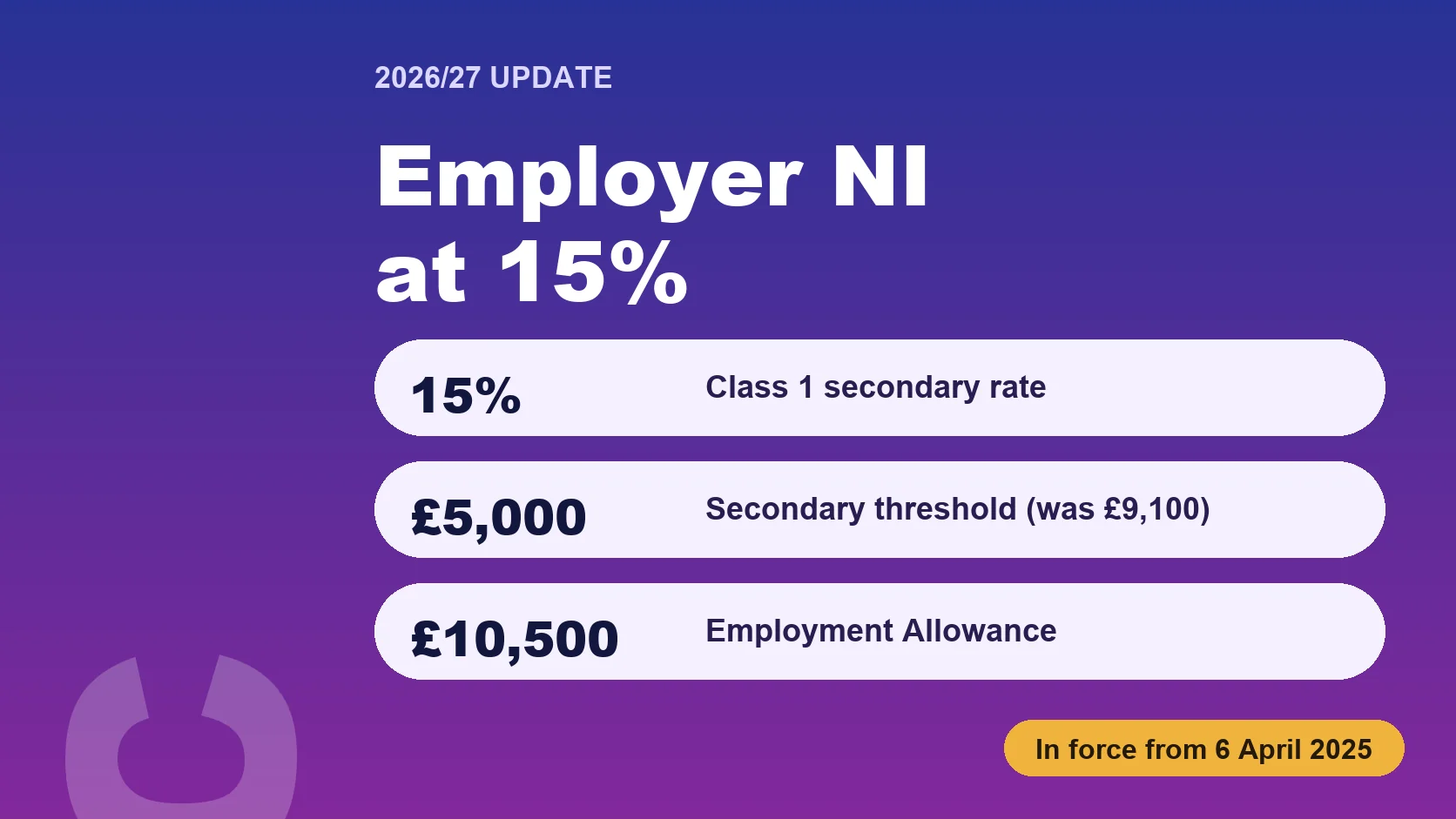
The 2026/27 tax year introduces significant changes to employer National Insurance contributions (NICs), with the secondary Class 1 employer rate rising to 15% from 6 April 2025. This rate is unchanged from 2025, meaning employers pay 15% on earnings above the secondary threshold of £5,000 per employee per year. The Employment Allowance has increased to £10,500 per year, up from £5,000, providing greater relief for qualifying employers. These changes affect all UK employers, including Ltd companies, sole traders, and owner-managers with employees.
This guide is for UK small and medium-sized enterprises, limited companies, payroll managers, and owner-managers working through the new employer NIC settings. It covers what changed in April 2025, how the figures carry into 2026/27, and the practical steps to take before your next payroll year.
What changed in April 2025 and what carries into 2026/27
The 2025 tax year brought a significant increase in employer NIC rates and thresholds, driven by the National Insurance Contributions (Secondary Class 1 Contributions) Act 2025. The secondary Class 1 employer rate rose from 13.8% to 15% effective 6 April 2025. This rate remains unchanged for 2026/27.
The secondary threshold, which was previously £9,100, was reduced to £5,000 per employee per year from the same date. This change effectively means that employers now pay 15% NIC on earnings above £5,000, rather than £9,100. This reduction significantly impacts small businesses with employees earning above the threshold.
The Employment Allowance also increased from £5,000 to £10,500 per year from 6 April 2025. At the same time the £100,000 prior-year NICs cap was abolished, so eligibility now turns on the underlying business rules rather than employer size. The two key exclusions remain in place: single-director companies where the director is the only person earning above the secondary threshold cannot claim the allowance, and public-sector bodies are generally excluded except where carrying on a genuine business activity.
Employer NI rates and thresholds for 2026/27
| Contribution Type | Rate | Threshold | Notes |
|---|---|---|---|
| Class 1 Secondary (Employer) | 15% | Earnings above £5,000 per year | Secondary threshold from 6 April 2025 |
| Class 1A (Benefits in kind) | 15% | On total taxable benefit value | Paid by employer only |
| Class 1B (PAYE Settlement Agreement) | 15% | On items inside the PSA, grossed up | Paid by employer only |
| Class 1 Primary (Employee) | 8% | Earnings between £12,570 and £50,270 | Employee deduction |
| Class 1 Primary (Employee) | 2% | Earnings above £50,270 | Above the upper earnings limit |
| Apprentices under 25, employees under 21, qualifying veterans (first 12 months) | 0% (employer) | Up to the upper secondary threshold of £50,270 | Employer NIC at 15% above £50,270 |
| Directors | 15% (employer) | Annual earnings period using the cumulative or alternative method | Per HMRC CA44 |
Employment Allowance: who still qualifies in 2026/27
The Employment Allowance is available to most employers carrying on a business. From 6 April 2025 the £100,000 prior-year NICs cap was abolished, so larger employers can now qualify too. The substantive exclusions are unchanged:
- Single-director companies where the director is the only employee paid above the secondary threshold cannot claim. Adding a second person on the payroll earning above £5,000 per year restores eligibility for the following tax year.
- Public-sector bodies, unless carrying on a genuine business activity such as a charity or community-amateur sports club.
- Connected companies can only claim the allowance once between them, applying the connection rules in the National Insurance Contributions Act 2014 (Schedule 1) which mirror the Corporation Tax associated-company tests.
The Employment Allowance reduces the employer's secondary Class 1 NIC bill by up to £10,500 per year. It does not reduce Class 1A or Class 1B charges.
Worked example: a 4-employee firm in 2026/27
Consider a Ltd company with four employees, each earning £30,000 per year. Before the changes in April 2025, the employer would have paid 13.8% NIC on earnings above the £9,100 secondary threshold. The calculation would have been:
- £30,000 - £9,100 = £20,900
- £20,900 × 13.8% = £2,884.20 per employee
- £2,884.20 × 4 = £11,536.80 total employer NIC
After the changes in April 2025, the employer now pays 15% NIC on earnings above the £5,000 secondary threshold:
- £30,000 - £5,000 = £25,000
- £25,000 × 15% = £3,750 per employee
- £3,750 × 4 = £15,000 total employer NIC
With the Employment Allowance of £10,500, the employer's net NIC bill is:
- £15,000 - £10,500 = £4,500
This represents an increase in employer NIC from £11,536.80 to £15,000, or £3,463.20, before the Employment Allowance. The Employment Allowance reduces this to £4,500, which is still significantly higher than the pre-2025 figure.
Worked example: director plus one employee
Consider a Ltd company with a director and one employee, both earning £30,000 per year. In this scenario, the Employment Allowance still applies because there are two employees, both earning above the secondary threshold.
- Employee 1: £30,000 - £5,000 = £25,000 × 15% = £3,750
- Employee 2: £30,000 - £5,000 = £25,000 × 15% = £3,750
- Total employer NIC: £7,500
- Employment Allowance: £10,500
- Net employer NIC: £0 (Employment Allowance covers the full amount)
This example shows that the Employment Allowance is still beneficial even when the total NIC liability is low, as it can fully offset the employer's NIC bill.
Class 1A and Class 1B at 15%
Class 1A and Class 1B NIC rates have also increased to 15% for 2026/27. Class 1A applies to benefits-in-kind (including P11D benefits), while Class 1B applies to PAYE Settlement Agreements (PSAs). These changes impact the overall cost of providing benefits to employees and managing payroll settlements.
For businesses using PSAs, the 15% rate on Class 1B NIC means that the cost of these arrangements will increase. Similarly, for businesses providing benefits-in-kind, the 15% Class 1A rate will increase the employer's NIC bill for these items.
Free employer NI calculator
Try the MBridge Employer NI Calculator →
Three mistakes small employers make
(a) Single-director companies trying to claim the Employment Allowance
The £100,000 prior-year cap was abolished from April 2025, but the single-director exclusion was not changed. A limited company whose only employee earning above the £5,000 secondary threshold is the sole director still cannot claim the £10,500 allowance. Putting a spouse or second employee on a real wage above the threshold restores eligibility for the following tax year, provided the employment is genuine.
(b) Forgetting Class 1A on benefits also moved to 15%
Another frequent error is overlooking the change in Class 1A rates. Employers providing benefits-in-kind must now account for the 15% rate on Class 1A NIC, which increases the cost of these benefits. This change affects businesses that provide company cars, private health insurance, or other benefits to employees.
(c) Not re-modelling salary sacrifice and pension contributions
With the secondary threshold reduced to £5,000, businesses must reassess their salary sacrifice and pension contribution strategies. These arrangements may no longer be as tax-efficient, as more of the employee's earnings will be subject to employer NIC at the 15% rate.
Practical steps for the next twelve months
- Audit your payroll records to identify all employees earning above the £5,000 secondary threshold.
- Re-evaluate your director's salary level to ensure it remains within the optimal range for tax efficiency.
- Analyse salary sacrifice and pension contribution arrangements to determine their continued benefit.
- File your Employment Allowance claim in your Employer Payment Summary (EPS) for the 2026/27 tax year.
- Plan for succession and consider how the changes might impact future company structure.
How MBridge helps
MBridge provides tools and guidance for UK small employers working through the new NIC settings. Our Employer NI calculator models the 2026/27 liability under the 15% rate, the £5,000 secondary threshold, and the £10,500 Employment Allowance, with directors, apprentices, and veterans handled separately. For wider payroll context, see our guide to the IR35 off-payroll working rules small-company exemption.
HMRC and legislation sources
- Rates and thresholds for employers 2026 to 2027
- HMRC CWG2: Employer Further Guide to PAYE and NICs
- National Insurance Contributions (Secondary Class 1 Contributions) Act 2025
- National Insurance Contributions Act 2014 (Employment Allowance)
- Claim the Employment Allowance
This guide is for information purposes only and does not constitute legal or tax advice. Employers should consult with a qualified accountant or tax advisor for specific advice.
Have a question about this article?
Our team is happy to help with any questions about UK compliance. Get in touch and we will get back to you within one working day.
Ask Us a Question