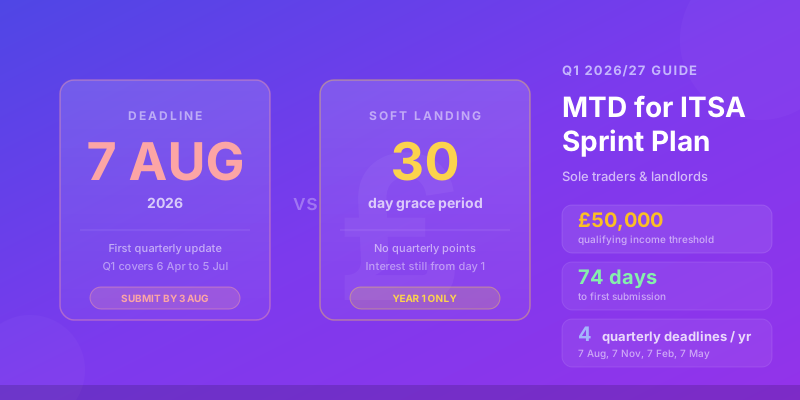
Making Tax Digital for Income Tax Self Assessment (MTD for ITSA) went live on 6 April 2026 for UK sole traders and landlords with qualifying income above £50,000. The first quarterly update for Q1 2026/27 is due on 7 August 2026, covering the period from 6 April to 5 July. From today's date that gives roughly ten weeks to test your software, link your bank feeds, categorise three months of transactions, confirm agent authorisation, and submit. The majority of people in scope have not started.
This guide is the tactical companion to our MTD for ITSA preparation guide. The preparation guide covered scope, thresholds, and the points based penalty regime in detail. Here we focus only on what to do, week by week, between now and submission day, plus the FAQs sole traders and landlords are sending us right now.
TL;DR
- Deadline: First MTD for ITSA quarterly update is 7 August 2026, covering 6 April to 5 July 2026.
- Who is in scope: UK sole traders and landlords whose gross qualifying income for 2024/25 exceeded £50,000.
- Soft landing: No penalty points for late quarterly updates in 2026/27. Late payment grace period extended from 15 to 30 days. Interest on unpaid tax still accrues from day 1.
- Coming next: £30,000 threshold from April 2027, £20,000 threshold from April 2028.
- Action: Submit Q1 by Monday 3 August 2026 to leave buffer for software glitches and HMRC API outages on the 7th.
Who has to file an MTD for ITSA quarterly update on 7 August 2026?
You are mandated into MTD for Income Tax from 6 April 2026 if all of the following apply:
- You are a UK resident individual.
- You file an SA103 page (self employment) or an SA105 page (UK property) on your Self Assessment return.
- Your gross qualifying income for the 2024/25 tax year was more than £50,000.
The threshold is on gross receipts, not taxable profit. A consultant turning over £40,000 plus £15,000 of rental income hits £55,000 and is in scope, even though their net profit is much lower. PAYE salary, dividends, savings interest and pension income are excluded from the qualifying income calculation.
Limited companies, partnerships, and trusts are not in scope from April 2026. The mandate currently applies only to individuals filing self employment or UK property pages.
What is the state of the first wave?
The first seven weeks of the mandate have surfaced a clear picture from the practitioners working it:
- A 2025 MTD readiness survey of more than 2,000 UK accounting firm members found that 85% were still in planning or pre-planning stages as the mandate approached, with only 15% actively implementing. 62% reported their clients were not prepared for quarterly submissions.
- HMRC's Tell ABAB Report 2024 to 2025 found 40.8% of respondents expected quarterly updates to significantly increase costs, 35.9% expected significant time increases, and 68.5% saw no commercial benefits to the mandate at all.
- HMRC's MTD ITSA APIs only moved from private to public beta in April 2024, two years ahead of go live, meaning software vendors had a compressed window to release stable products.
- Many sole traders are still unaware that submission is now quarterly, not annual.
The combination of unprepared filers, stretched agents, and recently stabilised APIs is the actual reason HMRC granted a soft landing for late quarterly updates in 2026/27. Soft landing is not a holiday. It is a recognition that the first quarter will be messy and that issuing penalty points across the entire first wave would have created a backlog of appeals that nobody can absorb.
What does the MTD for ITSA 2026/27 soft landing actually cover?
The 2026/27 soft landing is narrower than most people assume:
- Late quarterly updates: no penalty points for the first year. This is the main relief.
- Late payment penalties: the initial grace period is extended from 15 days to 30 days during 2026/27 only.
- Interest on unpaid tax: still accrues from day 1. There is no relief on interest, ever.
- Final declaration (due 31 January 2028): not covered by soft landing. The standard penalty regime applies.
- From April 2027: the late payment penalty rates currently set at 3% (at day 15 and day 30) rise to 4%. The annualised rate that kicks in from day 31 onwards stays at its current level.
The takeaway: you can miss the August submission this year without earning penalty points, but you cannot miss paying tax without interest. And from 2027/28, every quarterly slip earns a penalty point.
Key MTD for ITSA dates at a glance
| Date | Event | Notes |
|---|---|---|
| 6 April 2026 | MTD ITSA mandate goes live | £50,000 qualifying income threshold (measured on 2024/25) |
| 5 July 2026 | Q1 period closes | Reporting period is 6 April to 5 July |
| 7 August 2026 | Q1 quarterly update due | First MTD ITSA submission. Soft landing applies. |
| 7 November 2026 | Q2 quarterly update due | Period 6 July to 5 October |
| 7 February 2027 | Q3 quarterly update due | Period 6 October to 5 January |
| 31 January 2027 | Self Assessment balancing payment | Tax payment rhythm unchanged |
| 7 May 2027 | Q4 quarterly update due | Period 6 January to 5 April |
| 6 April 2027 | Threshold drops to £30,000 | Measured on 2025/26 income |
| 31 July 2027 | Self Assessment payment on account | Standard SA cadence |
| 31 January 2028 | Final declaration for 2026/27 due | Replaces legacy SA return. Not in soft landing. |
| 6 April 2028 | Threshold drops to £20,000 | Measured on 2026/27 income |
The 7 August 2026 sprint plan: week by week
Ten weeks. Here is what needs to happen, and roughly when.
Weeks 1 to 2 (now): confirm scope and choose software
If you have not already done so:
- Test your qualifying income. Add gross self employment turnover to gross UK property receipts for 2024/25. Over £50,000 means you are in scope. The test is on gross receipts, not profit.
- Decide on calendar quarters or tax year quarters. Calendar quarters (3 months ending 31 March, 30 June, 30 September, 31 December) align better with VAT for VAT registered businesses, but the election must be in place by 1 April in the first year of mandation. If you missed that for 2026/27, you are on tax year quarters by default (6 April to 5 July, and so on).
- Pick a recognised MTD ITSA product from HMRC's compatible software list. Filter for those that offer bank feeds, not just CSV import. Bank feeds satisfy the digital link requirement automatically. Copy and paste from a spreadsheet into a submission tool breaks the chain.
Weeks 3 to 4: agent authorisation and bank feeds
- Refresh your agent authorisation. The legacy 64-8 authorisation does not cover MTD for ITSA. Your accountant must request authorisation through the HMRC Agent Services Account, with a separate flow specifically for MTD for ITSA. Requests can take three to seven working days to clear in busy periods. Get this in before mid June.
- Connect every income source. If you have a business account at one bank, a rental account at another, and a personal account that occasionally receives business payments, all three feeds need to be set up. Missing a feed for two months means a frantic CSV reconciliation in late July.
- Apply your chart of accounts. Most products ship with HMRC compliant templates. Apply yours now and let the categorisation engines learn your patterns before the volume builds up.
Weeks 5 to 8: dry run the first quarter
- Reconcile to 5 July. The Q1 period closes on 5 July 2026. By the second week of July, every transaction from 6 April onwards should be categorised.
- Run a dry submission. Most MTD compatible products have a sandbox or preview mode that shows exactly what would be sent to HMRC. Do this at least two weeks before the deadline. Look for miscategorised transactions, missing receipts, and any feed gaps.
- Quarterly updates can include estimates. If you are waiting on a receipt or a late invoice, the regulations allow provisional figures, corrected at the final declaration. Use this if you need to. A provisional Q1 submitted on time is better than an accurate Q1 submitted late.
Final week (last week of July): submit early
- Submit by the morning of Monday 3 August. That gives four working days of buffer for software glitches, expired authorisations, or HMRC service outages. The HMRC API has had several short outages already in 2026 and the 7 August window will be its busiest day.
- Save the submission receipt. Every MTD product issues a confirmation reference. File it alongside your records. If HMRC later queries the submission, the receipt is the fastest route to proving on time delivery.
Free MTD compliance checker
Test where you actually stand against the £50,000 (2026/27), £30,000 (2027/28), and £20,000 (2028/29) thresholds, confirm whether your record keeping meets the digital link rule, and get the exact set of quarterly deadlines for your situation.
[[CALCULATOR:mtd-compliance-checker]]
Three mistakes sole traders are making in the first quarter
1. Treating the first quarter as a tax payment
Quarterly updates are reports, not payments. You still pay tax on the 31 January and 31 July rhythm. The Q1 submission summarises income and expenses for the quarter, but HMRC does not draw down tax against it. Several people in the first wave have asked their accountants to set aside cash for an August tax bill that does not exist. Plan tax payment from your existing Self Assessment knowledge, not from the quarterly cadence.
2. Assuming bridging software is a long term answer
Bridging software (an Excel to API adapter) keeps existing spreadsheet workflows alive in the short term and is a reasonable bridge for 2026/27. It is not a long term plan. As scope drops to £30,000 in 2027/28 and £20,000 in 2028/29, HMRC compliance work will lean increasingly on the digital link standard, and a spreadsheet plus bridging tool stack is harder to defend than a single cloud product with native digital links. Use bridging as a stopgap, not as a strategy.
3. Ignoring the property income column on generic accounting tools
Sole trader bookkeeping tools sometimes do not handle UK property income out of the box. If your qualifying income is mostly rental, look for a product that supports the SA105 categories natively (mortgage interest restriction, repairs versus improvements, allowable expenses by property). A general purpose tool that forces you to shoehorn rental income into business categories will fail the quarterly summary on first inspection and create remediation work at the final declaration.
Practical steps for the next twelve months
- By 8 June 2026: confirm scope, pick compatible software, complete the agent authorisation request through the HMRC Agent Services Account.
- By 6 July 2026: bank feeds live for every income source, chart of accounts applied, first month of transactions categorised.
- By 14 July 2026: Q1 reconciliation complete, dry submission run, any feed gaps fixed.
- By 3 August 2026: actual Q1 submission filed, confirmation receipt saved.
- From 6 August 2026 onwards: same rhythm for Q2 (deadline 7 November 2026), Q3 (deadline 7 February 2027), Q4 (deadline 7 May 2027).
- By 31 January 2028: final declaration for 2026/27. This replaces the legacy Self Assessment return. Still covered by the standard penalty regime, not soft landing.
- Plan ahead for 2027/28: scope drops to £30,000 qualifying income, based on your 2025/26 figures. If you are close to that threshold this year, you are next in the queue.
Frequently asked questions about MTD for ITSA quarterly updates
When is the first MTD for ITSA quarterly update due?
The first MTD for ITSA quarterly update is due 7 August 2026, covering the period 6 April 2026 to 5 July 2026. Subsequent quarterly updates fall on 7 November 2026, 7 February 2027 and 7 May 2027 for the 2026/27 tax year.
Who has to use Making Tax Digital for Income Tax from April 2026?
UK resident individuals whose gross qualifying income from self employment and UK property exceeded £50,000 in the 2024/25 tax year. Partnerships, limited companies and trusts are not in scope from April 2026.
How is the £50,000 MTD for ITSA threshold calculated?
The threshold uses gross receipts, not taxable profit. Add gross self employment turnover (your SA103 income) to gross UK property income (your SA105 income) before any expenses. PAYE salary, dividends, savings interest and pension income are excluded from the calculation.
What software do I need for MTD for ITSA?
Any product on HMRC's compatible software list. The features that matter most in practice are direct bank feeds (these satisfy the digital link requirement automatically), SA103 and SA105 native categories (especially if you have rental income), and agent collaboration through the HMRC Agent Services Account.
Will I be fined if I miss the 7 August 2026 deadline?
Not for the late quarterly update itself. HMRC has confirmed a soft landing for 2026/27, meaning no penalty points are issued for late quarterly updates during the first year. However, if you have a balancing payment outstanding, interest still accrues from day 1, and from 2027/28 every late submission earns a penalty point toward the four point fine threshold.
Do I have to pay tax quarterly under MTD for ITSA?
No. Tax payment deadlines remain on the standard Self Assessment rhythm: 31 January (balancing payment plus first payment on account) and 31 July (second payment on account). MTD for ITSA changes how you report your income, not when you pay tax on it.
Can I still use a spreadsheet under MTD for ITSA?
Yes, but only if every transfer onward from the spreadsheet to HMRC is a digital link. That usually means using bridging software that connects to your spreadsheet via an API. Manual copy and paste between a workbook and a submission tool breaks the digital link chain and will trigger compliance issues once the soft landing ends.
When does MTD for ITSA expand to lower income thresholds?
The threshold drops to £30,000 from 6 April 2027 (based on 2025/26 qualifying income) and to £20,000 from 6 April 2028 (based on 2026/27 qualifying income). Partnerships are expected to come into scope at a later date that has not yet been confirmed.
What is the difference between a quarterly update and the final declaration?
A quarterly update is a digital summary of income and expenses for a three month period, submitted through MTD compatible software. It does not create a tax liability. The final declaration is the annual reconciliation that replaces the legacy Self Assessment return, due by 31 January following the end of the tax year. It calculates the actual tax liability and is not covered by the 2026/27 soft landing.
How MBridge helps UK SMEs with MTD for ITSA
MBridge Technologies builds privacy first compliance tooling for UK SMEs. Our MTD compliance checker is part of a wider suite of 33 calculators covering IR35, directors' loans, employer NI, capital gains, dividend tax, VAT registration, and the rest of the HMRC obligations small businesses carry. Everything runs on UK hosted infrastructure with no customer data leaving the country, which matters as compliance touchpoints multiply and the volume of tax data flowing through third party software grows.
Related guides on the MBridge blog:
- Making Tax Digital for ITSA: full preparation guide
- HMRC in 2026: what small businesses really need to sort out now
- UK VAT registration threshold 2026/27
- Employer National Insurance 2026/27
If MTD for ITSA is on your horizon, the readiness checker is the fastest way to find out where you stand and what to fix first.
HMRC and legislation sources
- The Income Tax (Digital Requirements) Regulations 2021 (SI 2021/1076)
- Schedule 24 Finance Act 2021 (penalties for failure to make returns etc)
- HMRC: Overview of Making Tax Digital
- HMRC: Check if you need to use Making Tax Digital for Income Tax
- HMRC: Find software compatible with Making Tax Digital for Income Tax
- HMRC: Get an exemption from Making Tax Digital for Income Tax
- HMRC: Tell ABAB Report 2024 to 2025
- HMRC: Penalty reform for Making Tax Digital for Income Tax Self Assessment volunteers
- ICAEW: MTD for income tax penalties
This article is general information based on HMRC guidance and legislation in force at the time of writing (25 May 2026). It does not constitute tax or legal advice. Always confirm your specific position with a qualified adviser before acting.
Have a question about this article?
Our team is happy to help with any questions about UK compliance. Get in touch and we will get back to you within one working day.
Ask Us a Question